Marriage Biodata Photo Tips: Why Yours Is Probably Wrong
You scroll through your phone for ten minutes, find a photo from your cousin's wedding where you looked great, and crop it for the biodata. It seems like the obvious choice. It's usually the wrong one.
The photo on a marriage biodata does more than show a face. It sets the first impression at someone else's dinner table, where a family is reading your biodata before they have ever met you. The context is different from a social media post. The stakes are different from a profile picture. And yet most people treat the biodata photo as an afterthought — a quick crop from the best recent photo they already have.
This guide covers the three most common biodata photo mistakes and, more importantly, what to do instead.
Why the Biodata Photo Matters More Than You Think
When a family receives your biodata, they will look at the photo before they read a single line. Research on first impressions consistently shows that photo-based judgments form within milliseconds — and, crucially, they are sticky. Even after a family meets you in person, they will carry their initial photo impression into that first conversation.
A well-chosen photo does not need to make you look extraordinary. It needs to make you look like yourself — composed, genuine, and ready to be known. A poorly chosen one creates a small but persistent doubt that no amount of good qualifications can fully undo.
Mistake 1: The Wrong Event Photo
The most common biodata photo in circulation is one taken at a cousin's wedding or a festival gathering — hair done, makeup on, dressed beautifully, surrounded by the warmth of a celebration.
And honestly — you look wonderful in it. The occasion was joyful, the styling was careful, and the photo shows it. But here is the problem: that photo was taken for a different context entirely.
Wedding and festival photos carry visual signals — heavy styling, elaborate jewellery, a celebratory background — that can overwhelm the person in the image. The other family is trying to understand who you are on an ordinary day. When the photo shows a version of you that only exists at peak celebrations, it creates a subtle disconnect when you meet in person.
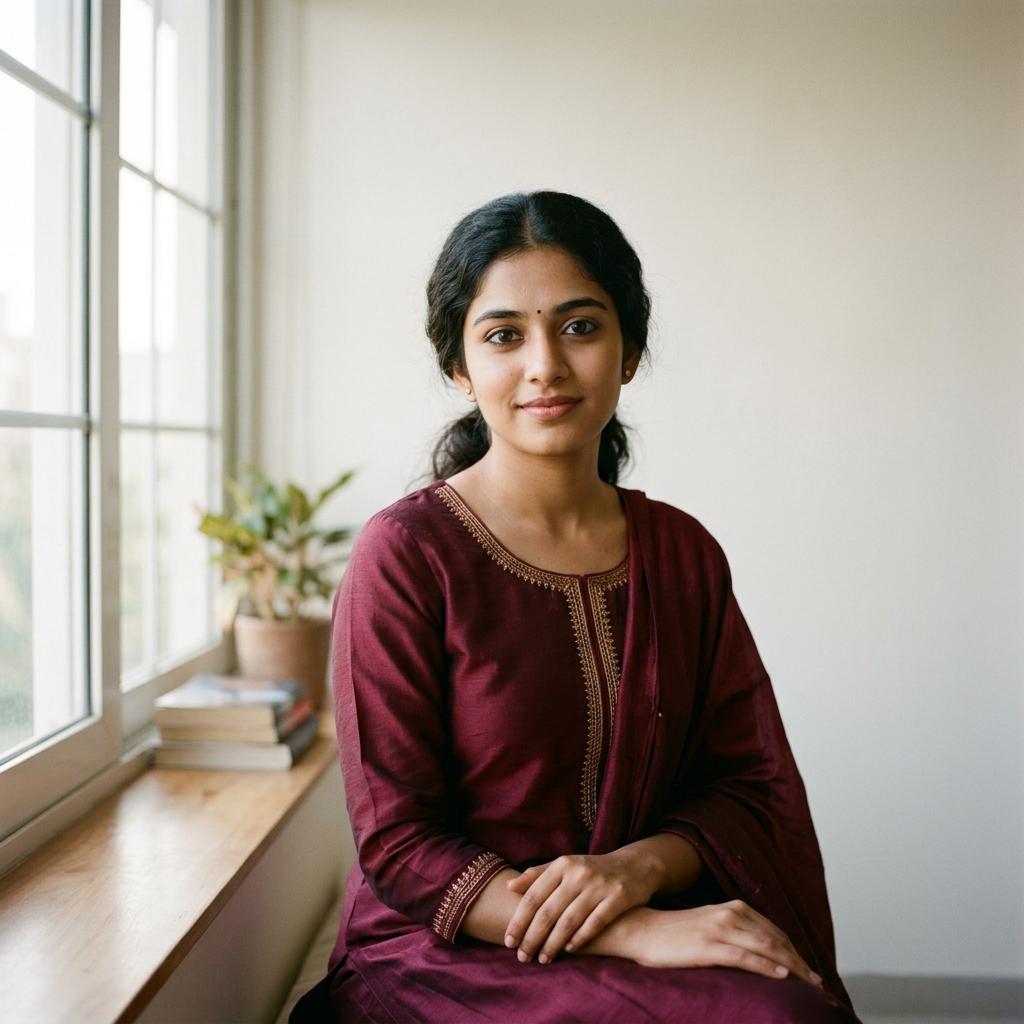
What to do instead: Take a dedicated photo in semi-formal or traditional attire on a regular day — a well-lit room, a plain wall, clothes you'd wear to meet an elder family member for the first time. The goal is to look like you at your thoughtful best, not your most dressed.
Mistake 2: An Old Photo or One Heavily Edited
The second mistake is using a photo that is more than two years old, or one that has been significantly filtered or retouched.
It is easy to understand the impulse — that photo from three years ago was taken on a good day, with good light, and you looked exactly as you hoped. But biodatas circulate for months. Families shortlist, revisit, and compare. By the time you sit across from them, you are a different iteration of yourself than the one in the photo. That gap — even a small one — registers as a mismatch.
Heavy filters carry the same risk. When you meet in person, the contrast between the filtered photo and your natural appearance creates a moment of recalibration that no one forgets, even if no one mentions it.
What to do instead: Use a photo taken within the last six to twelve months, with minimal or no editing beyond basic exposure correction. The photo should look like you on your best current day — not a different version of you from the past.
Mistake 3: Choosing the Photo Yourself
This one surprises people — but it is backed by real evidence.
Studies on photo selection consistently show that people are poor judges of their own best photograph. When we look at photos of ourselves, we notice things others do not: an expression we remember feeling self-conscious about, a detail that recalled an awkward moment, a shadow that seemed unflattering in the moment. These memories colour our judgement.
Neutral observers — people who were not in the room when the photo was taken — evaluate photos purely on how they appear, which is exactly what the other family will do. Research published in behavioural science journals notes that "other-selection" (having someone else choose your photo) consistently produces better first impressions than self-selection.
Ask your sibling, a close friend, or a parent to choose from three or four options without your commentary. Give them no hints about your preference. Their choice will almost always outperform yours.
What to do instead: Take four or five photos in the conditions described above. Hand them to someone who knows you well and ask: "Which one looks most like me on a good day?" Use that one.
Once you have the right photo, the rest of your biodata is ready to come together. The template, the sections, the layout — all of it is waiting for the photo you just put this much thought into choosing.
Ready to create yours?
Build a beautiful, print-ready marriage biodata in minutes — for free.
The Marriage Biodata Photo Checklist
Use this before finalising your biodata photo:
- Recent: Taken within the last 6–12 months
- Solo: Only you in the frame — no group photos, no cropped pairs
- Uncluttered background: Plain wall, neutral colour, no distractions behind you
- Natural lighting: Near a window, or in a well-lit room — no harsh flash
- Appropriate attire: Traditional or semi-formal — clean, composed, appropriate for a family introduction
- Minimal editing: Brightness correction only — no filters, no skin smoothing, no reshaping
- Warm expression: A natural, composed look with gentle eye contact — not stiff, not posed
- Other-selected: Chosen by someone else from multiple options, not by you alone
When all eight items are checked, your photo is ready. The next step is building the biodata that carries it — free to start, no account required.
A Note on Attire
In Indian matrimonial contexts, traditional attire in at least one photo signals cultural alignment — it communicates familiarity with family values and respect for the process. This does not mean you cannot include a semi-formal or contemporary photo alongside it. In fact, having two photos — one in traditional attire and one in everyday semi-formal clothing — gives families a fuller, more honest sense of who you are.
What matters is that the photo feels considered. A family can tell the difference between a photo taken with care and one pulled from an archive in five minutes.
Frequently Asked Questions
Do I need a professional photographer? Not necessarily. A professional studio gives you controlled lighting and a clean background, which helps — but a well-lit room, a plain wall, and a friend with a modern smartphone camera can produce an excellent biodata photo. What matters is the conditions, not the equipment.
Can I use my corporate headshot? A corporate headshot works as a starting point — it is recent, solo, and professionally composed. However, if your workplace requires extremely formal attire or has a stark corporate aesthetic, consider having a warmer, softer version taken separately. A biodata introduction is personal, not professional.
Should I smile in the photo? A natural, composed expression works better than either a forced smile or an overly serious look. Aim for the expression you'd have at the beginning of meeting someone you're looking forward to knowing — warm, calm, and present.
Conclusion
A biodata photo is not a glamour shot. It is not a social media update. It is an introduction — the first moment another family begins to form an impression of who you are, before you have had a chance to say a word in the room.
Give it the same thought you would give to what you wear to a first meeting. Because in many ways, it is the first meeting.
When your biodata is ready to carry the photo it deserves, Saat Vachan is here to help you put it together.
Saat Vachan
Your perfect biodata is one click away.
Choose from royal traditional templates, fill in your details, and download a print-ready PDF — free to try, no sign-up required.
Create Your Biodata FreeContinue Reading